The Heart of Craiova
Craiova is best discovered on foot — from Mihai Viteazul Square to Minerva Confectionery, every corner has a story to tell.
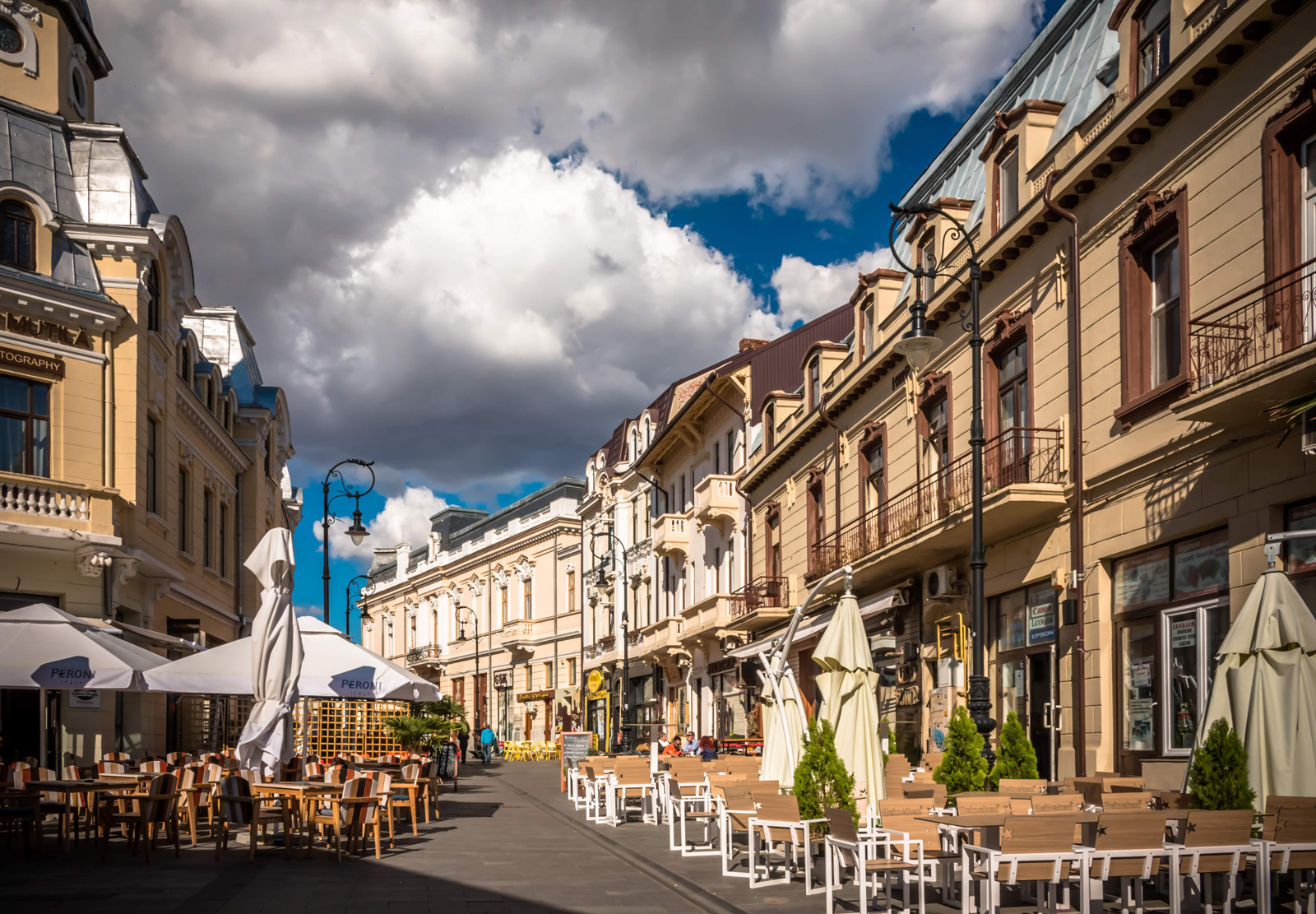
📍 Craiova's Kilometer Zero
🏛️ Central Square · Civic Monument · Alive Day and Night
The Heart of Craiova — the city's central square is bordered by four exceptional architectural landmarks: the Administrative Palace to the east, Mercur Mall (the renovated former Mercur store) to the south, the former Hotel Palace building to the north and the Prefecture Park to the west. In the center of the square dominates the equestrian statue of Mihai Viteazul, the voivode who achieved the first union of the Romanian principalities in 1600.
The square is lively at any time of the day — cafes and terraces with affordable prices, spontaneous concerts, seasonal fairs and, in winter, the #1 Christmas Market in Europe. The surrounding buildings can be best admired in the evening, when the architectural lighting gives them a special magic.
The choreographed artesian fountain in Mihai Viteazul Square is the largest musical fountain in Romania — synchronized shows of lights, colors and water dancing to music on summer evenings (May–September). In winter, the fountain is transformed into the Christmas Market ice rink. Shows take place in the evening and last 20–30 minutes, at regular intervals — a magical moment not to be missed!
Mihai Viteazul Square is spectacular in the evening from 20:00, when the architectural lighting of the Administrative Palace and the musical fountain show (May–September) create an unforgettable atmosphere. If you come in winter, sign up for the ice rink in the square or enjoy the warm mulled wine at the Christmas Market.
5 squares, 5 stories
Every square in central Craiova has a distinct personality and its own architecture — a walk through all of them can take 2–3 pleasant hours.
The heart of the city with the equestrian statue, musical fountain and Administrative Palace. Host of the #1 Christmas Market in Europe. Terraces, cafes and non-stop urban life.
Somewhat quieter than the central square, with splendid eclectic architecture. One of the Christmas Market stages — concerts on weekends. Authentic old neighborhood atmosphere.
The National Theatre Esplanade — the site of the 40m panoramic wheel in the Christmas Market and Shakespeare Festival performances. The theatre's architecture, inaugurated in 1973, dominates the space.
Doljana area — a square with a bohemian character and terrace atmosphere, one of the Christmas Market stages, with specific thematic decorations. Perfect setting for evening photos.
Small green square around Saint Dumitru Cathedral, one of the most important places of worship in Craiova (built 1889–1936). A space of peace and prayer in the heart of the busy city.
Craiova Architecture
From Petre Antonescu's Neo-Romanian to Thoma Dobrescu's Moorish — Craiova is an open-air architecture museum.
Craiova's calling card — the dominant building of Mihai Viteazul Square. Designed by the renowned architect Petre Antonescu and built between 1912 and 1913, it is a masterpiece of the Neo-Romanian style with Byzantine and Brâncovenesc influences. Damaged in World War I, later restored, preserving the original appearance. Today the headquarters of the Prefecture and Dolj County Council. The fascinating exterior can be admired freely.
One of the oldest and most important theatrical institutions in Romania, founded in 1850. It operates in the current building from 1973, located on Alexandru Ioan Cuza St. In its 175 years of existence, it has hosted world-prestigious performances. Since 1994, it organizes the International Shakespeare Festival — the largest in the world (World Record 2024). Visit it in the evening when the stage lights give it a magnetic aura.
Designed by the French architect Paul Gottereau and built between 1898–1907 for the Nabob Constantin Dinu Mihail. Fascinating interior: Carrara marble, Murano crystal, Venetian mirrors, Lyon silk and gilded stuccos. The plan resembles Cheverny Castle on the Loire Valley. Since 1954, it houses the Art Museum with 8,000 works, including 6 original Brâncuși. National Historical Monument.
Heritage building built in the early 20th century according to the plans of architect Otto Hesselmann. Over time it has hosted the National Tourism Office, CEC and Romanian Commercial Bank. Today it is an administrative pavilion of the Craiova Municipality City Hall. The elegant facade, visible from Mihai Viteazul Square, is one of the defining elements of the central urban landscape.
An architectural gem located on Mihail Kogălniceanu St. no. 1, built in Moorish style (1898–1903) according to the plans of architects Thoma Dobrescu and D. Nedelcu — unique in Craiova. The current confectionery was opened in 2015, remarkable for the exclusive use of 100% natural ingredients. Reference artisan eclairs and cakes for Craiovans. A mandatory stop at the end of any walk on Calea Unirii.
Built in 1920, the Ramuri Palace initially housed the famous "Ramuri" publishing house and bookstore, the most important in interwar southern Romania. Today it hosts the Natural Sciences Section of the Oltenia Museum, with a planetarium and naturalistic collections. The representative facade is seen from Mihai Viteazul Square — one of the essential components of Craiova's central architectural landscape.
The oldest civil building in Craiova — erected in the 15th c. by the Craiovești boyars, the residence of the Great Ban of Oltenia. Renovated by the ruler Constantin Brâncoveanu. It hosted historical personalities, including the ruler Alexandru Ioan Cuza in 1859. Today it houses the Ethnography Section of the Oltenia Museum, with collections of folk costume, ceramics and traditional textiles. Category A Historical Monument.
Heritage building located in Piața Veche (Elca Square), built by the merchant Niță D. Puțureanu — a wonderful ensemble with inn architecture specific to the 19th c., the only one of this type remaining in Craiova. Located in proximity to St. Dumitru Cathedral, Oltenia Museum, Madona Dudu Church and Baniei House. Although in the restoration stage, the exterior is worth photographing — a living testimony of Craiova's former commercial life.
The University of Craiova is housed in an imposing building through architecture and dimensions, adjacent to the Marin Sorescu National Theatre — together forming a reference academic and cultural ensemble for the city center. Founded in 1947, today it hosts over 30,000 students and is one of the largest universities in southern Romania. The inner courtyard and festive hall can be visited during open public events.
Craiova Promenade
Completely regenerated, Craiova's old town is today a "kilometer zero" of the promenade, cultural life and local gastronomy.
Pedestrian artery connecting Mihai Viteazul Square to Minerva Confectionery. Restored eclectic buildings, animated terraces, bookstores and art galleries. The basic route of any visit to Craiova.
Restored area with restaurants, pubs and cafes in historic buildings. In the evening, the terraces are full — requires reservation on weekends. The bohemian atmosphere of authentic Craiova. Includes Saint Elias Church (1893, on the site of a foundation from 1710).
Mihai Viteazul Square → National Theatre → Art Museum (Jean Mihail Palace) → Brâncuși Center → Baniei Houses → St. Dumitru Cathedral. The most complete cultural walking tour.
Administrative Palace → Former Hotel Palace → Ramuri Palace → Jean Mihail Palace → Minerva Confectionery. A tour of eclectic architecture from 5 distinct styles, all within a 500-meter radius.
Craiova's center is superb in the evening — architectural lighting highlights every detail of the palaces and historical buildings. Ideal route: leave Mihai Viteazul Square after sunset, watch the musical fountain show (May–Sept), walk on Calea Unirii towards Minerva Confectionery, then return on Lipscani St. for dinner at your favorite terrace. Total: 2 hours, 0 lei transport.
Savor at your pace
Craiova's Old Town hides places with personality — from the legendary confectionery to terraces with Oltenian specifics.
Moorish building from 1898. The best natural eclairs in Craiova. Kogălniceanu St. no. 1.
Specialty coffee shops in restored buildings on Lipscani St. and Calea Unirii.
Tripe soup, sarmale and mici — in traditional restaurants in the Mihai Viteazul Square area.
Lipscani area offers animated pubs and terraces with live music on summer evenings.
Opposite the National Theatre. Renowned for its eclairs — guaranteed queue on weekends.
In summer, several local artisan ice cream producers populate the old town terraces.
Frequently asked questions
Craiova's center is Mihai Viteazul Square, dominated by the equestrian statue of the unifying voivode and the Administrative Palace (1912, Neo-Romanian style, architect Petre Antonescu). Nearby are: the musical fountain (the largest in Romania), Marin Sorescu National Theatre, Art Museum in Jean Mihail Palace (5 minutes walk), Old Town (Lipscani area) with restaurants and terraces, and Calea Unirii — the main promenade to Minerva Confectionery.
The choreographed artesian fountain in Mihai Viteazul Square is the largest musical fountain in Romania — synchronized shows of lights, colors and water to music. It operates on summer evenings (May–September), with shows at regular intervals from sunset. In winter, during the Christmas Market period (November–January), the fountain is transformed into an ice rink — one of the main attractions of the holidays.
The Administrative Palace in Craiova was built between 1912 and 1913 by the renowned architect Petre Antonescu, in Neo-Romanian style with Byzantine and Brâncovenesc influences. It is one of the masterpieces of the Neo-Romanian style promoted by the architect Ion Mincu and his school. Damaged in World War I, it was later restored, preserving the original appearance. Since 1989 it serves as the headquarters of the Prefecture and Dolj County Council.
Yes! Craiova's Old Town has a similar area — regenerated and revitalized, with restaurants, cafes and pubs in the city's historic buildings. The area is organized around Calea Unirii and Mihai Viteazul Square. The Old Town has been transformed into the "kilometer zero" of the promenade and urban fun, with a bohemian and authentic atmosphere. Lipscani Street is the main artery of this area in Craiova.
Casele Băniei (Baniei Houses, 16 Matei Basarab St.) are the oldest civil edifice in Craiova, dating from the 15th century, founded by the Craiovești boyars as the residence of the Great Ban of Oltenia. They were renovated by the ruler Constantin Brâncoveanu and represent a monument of medieval Brâncovenesc architecture. Today they house the Ethnography Section of the Oltenia Museum and are declared a Category A Historical Monument.