The Museum of Romanian Book and Exile in Craiova is a unique institution in the national cultural landscape, representing the most ambitious project to recover the intellectual memory of the Romanian diaspora. Housed in the elegant Dianu House, the museum brings back home thousands of rare books, original manuscripts, private correspondence and personal objects of those who kept Romanian culture alive across borders during the communist regime.
Officially inaugurated in September 2023, the museum is the result of a vision started in 2016 by the management of the "Alexandru and Aristia Aman" County Library, supported by academicians and great personalities of the exile. Today, inestimable funds donated by Basarab Nicolescu, Mircea Eliade, Emil Cioran, George Banu, Aurora Cornu and many others can be researched here — a treasure that transforms Craiova into a world center for the study of Romanian exile.
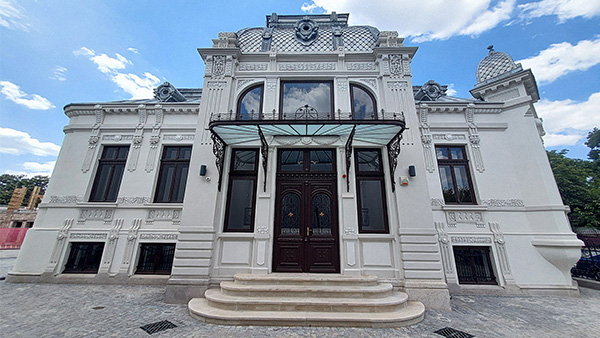
Dianu House — a spectacularly restored historical monument to house the treasure of exile
Dianu House — The Museum Seat
Construction: late 19th century
The museum is based in Dianu House, one of the most beautiful heritage buildings in Craiova. Built at the end of the 19th century (approx. 1880-1900) as the residence of the Dianu family — a family of landowners and influential intellectuals of the era — the building is a remarkable example of eclectic architecture with neoclassical influences.
After decades of degradation, the building was saved through an extensive restoration project funded by European funds. The works brought to light original mural paintings, gilded stuccos, period woodwork and terracotta stoves of exceptional aesthetic value. Today, the interiors of Dianu House provide a perfect noble setting for the manuscripts and books signed by the great minds of the exile.
The Museum Concept
Recovery and TechnologyThe Museum of Romanian Book and Exile is not a traditional library, although it houses over 100,000 volumes. Its concept is that of an interactive museum, where documents are highlighted through modern technology: touch screens, video projections, audio listening points and digital research spaces.
Each salon of the museum is dedicated to a personality or a group from the exile, being arranged to evoke the creative universe of the donor. It is a "living" institution, where permanent exhibitions coexist with restoration workshops, conference halls and areas dedicated to young researchers.
Core Collections and Treasure
38 inestimable fundsThe museum brings together over 38 major collections, each representing the universe of a prominent personality. Among the most important are:
Mircea Eliade and Emil Cioran Funds
Pillars of universal cultureThe museum holds treasure pieces related to the most important Romanian intellectuals of the 20th century. The Mircea Eliade fund includes first editions of his works published in dozens of languages, correspondence and documents that attest to his permanent connection with Romanian spirituality.
"Through this museum, Craiova becomes a mandatory point on the world map of studies about Romanian culture in exile."
— Basarab Nicolescu, donor and academicianThe Emil Cioran collection includes volumes with holograph annotations, rare books and documents that shed light on his Parisian period. The presence of these funds in Craiova is a magnet for researchers from all over the world.
🤫 Curiosities and Secrets
Unpublished dedications. Many of the books in the Basarab Nicolescu collection contain holograph dedications signed by Mircea Eliade, Emil Cioran or Eugène Ionesco, offering details about the close friendships within the "golden triangle" of the Parisian exile.
Dianu House and Communism. During the communist regime, this architectural gem was the seat of the Popular School of Art. The recent restoration managed to remove layers of cheap paint, discovering original 19th-century mural paintings underneath.
Voices of Exile. The museum holds unique audio recordings of Radio Free Europe broadcasts, offering visitors the chance to hear the voices that provided hope to Romanians for 40 years.
Connection with the great diplomat Titulescu. The museum contains documents referring to the activity of Nicolae Titulescu, the Craiova-born diplomat who prefigured, in his own way, the European spirit of the later exile.
📋 Practical Information 2026
🕙 Hours
Mon – Fri: 09:00 – 17:00Saturday, Sunday: Closed (except for events)
🎟️ Fees
Single ticket 15 leiValid 15 days for 7 museum sections.
📍 Address
4 24 Ianuarie St.Craiova, Dolj (near Colibri Theatre)
🚌 Transport
Tram: 1, 2 (National Theatre Stop)
5 min walk from center
🏛️ Nearby
Marin Sorescu National Theatre
Art Museum (5 min walk)
📱 Contact
Tel: 0251 412 342
Email: contact@muzeulexilului.ro
Use the 15 lei Single Ticket offered by the Dolj County Council. It allows you to visit in 15 days this museum, as well as the 3 sections of the Museum of Oltenia, the Art Museum (Jean Mihail Palace) and the Elena Farago Memorial House. It is the best cultural offer in Romania!
❓ Frequently Asked Questions
Although it is an institution of national interest, the museum was created in Craiova due to the initiative of the "Alexandru and Aristia Aman" County Library, which managed to gain the trust of donors in exile through serious document recovery projects started as early as 2013. The Dolj County Council provided the necessary infrastructure through the spectacular restoration of Dianu House.
Yes, the museum houses not only books, but also personal objects: typewriters, glasses, office furniture, personal journals and clothes that belonged to the great thinkers. The "George Banu" fund, for example, includes a faithfully reconstructed corner of a Parisian library.
Absolutely. The museum has a strong research component. Many of the scanned documents can be consulted in the multimedia rooms, and accredited researchers can have access, under controlled conditions, to the museum's physical archives.